Calculate air-freight volumetric and chargeable weight from packed dimensions, quantity and gross weight, with clear carrier-divisor caveats.
How is air-freight chargeable weight calculated?
Compare the shipment’s actual gross weight with its volumetric weight. The higher result is the planning chargeable weight, subject to the booked carrier’s divisor, rounding and minimum rules.
- Measure the packed pieces
- Use the greatest external length, width and height after all packaging, wrapping and pallet overhang are included.
- Calculate volume weight
- Multiply centimetre dimensions by the number of identical pieces, then divide by the carrier’s divisor.
- Compare actual weight
- Use the greater of total actual gross weight and total volumetric weight for planning.
- Confirm the tariff
- A 6,000 divisor is common for air cargo, but some services use 5,000 or another contractual basis.
- Apply final rules
- Carrier rounding, minimum weights and service-specific charges are confirmed in the quote rather than invented by the calculator.
Air freight volumetric weight calculator
Enter the completed external dimensions for identical packages. The result compares volume weight with total actual gross weight; it is not a freight price or carrier acceptance.
Final carrier rounding, minimum charges, route restrictions and the rest of the freight quote are not included.
Request an air freight quoteAir-freight chargeable weight is normally based on the greater of the shipment’s actual gross weight and its volumetric weight. A common planning formula is length × width × height in centimetres ÷ 6,000, calculated across every package. The booked airline, route and service still control the divisor, rounding and any minimum charge, so use the calculator as a planning result rather than a final rate.
Air freight volumetric weight formula
For packages with the same dimensions, the common 6,000-divisor calculation is:
Volumetric weight (kg) = length (cm) × width (cm) × height (cm) × quantity ÷ 6,000
Then compare the result with the shipment’s total actual gross weight:
Planning chargeable weight = whichever is greater: actual gross weight or volumetric weight
IATA describes 6,000 cubic centimetres per kilogram as the general air-cargo rule and states that carriers may charge by volumetric or actual weight. DHL Global Forwarding publishes the same 1:6 density ratio for its air-freight example while warning that a carrier can apply a different ratio. That distinction matters: 6,000 is a useful default, not a promise that every express, airline or contracted service will use it.
How to use the calculator
Enter the completed package’s greatest external length, width and height in centimetres. Add the number of identical pieces and the total actual gross weight of those pieces. Select the divisor stated by the carrier or quote; leave 6,000 selected when you only need the common air-freight planning basis.
The calculator returns four separate figures:
- Total volume: the external cubic capacity occupied by all identical pieces, shown in cubic metres.
- Volumetric weight: total cubic centimetres divided by the selected divisor.
- Actual gross weight: the physical weight entered for all pieces, including packaging and pallets.
- Planning chargeable weight: the higher of actual and volumetric weight before carrier rounding, minimums or tariff rules.
If the shipment contains packages with different dimensions, calculate each size group separately and add the resulting volume weights. Compare the combined volume weight with the combined actual gross weight. Do not multiply one package’s dimensions by the total quantity unless every piece is genuinely the same external size.
Worked example: one lightweight carton
A carton measures 50 cm × 40 cm × 30 cm and weighs 8 kg. Using a divisor of 6,000:
50 × 40 × 30 ÷ 6,000 = 10 kg volumetric weight
The volumetric result is 10 kg and the actual gross weight is 8 kg, so the planning chargeable weight is 10 kg. The carton is relatively light for the space it occupies. The final air-freight quote may still use a carrier-specific rounding rule or minimum charge.
Worked example: several identical cartons
Four cartons each measure 60 cm × 50 cm × 40 cm. Together they weigh 110 kg. Using 6,000:
60 × 50 × 40 × 4 ÷ 6,000 = 80 kg volumetric weight
The actual gross weight of 110 kg is higher than the 80 kg volumetric result, so 110 kg is the planning chargeable weight before any tariff minimums or rounding. This is why dimensions and weight must both be supplied: neither figure can safely substitute for the other.
Worked example: different package sizes
A shipment has two large cartons and three smaller cartons:
| Package group | Dimensions | Quantity | Volume weight at 6,000 |
|---|---|---|---|
| Large cartons | 80 × 60 × 50 cm | 2 | 80 kg |
| Small cartons | 40 × 30 × 25 cm | 3 | 15 kg |
| Combined | — | 5 | 95 kg |
If the five pieces have a combined actual gross weight of 72 kg, the planning chargeable weight is 95 kg. A mixed shipment should be calculated group by group rather than treated as five copies of the largest carton.
Measure packed freight, not the unpacked product
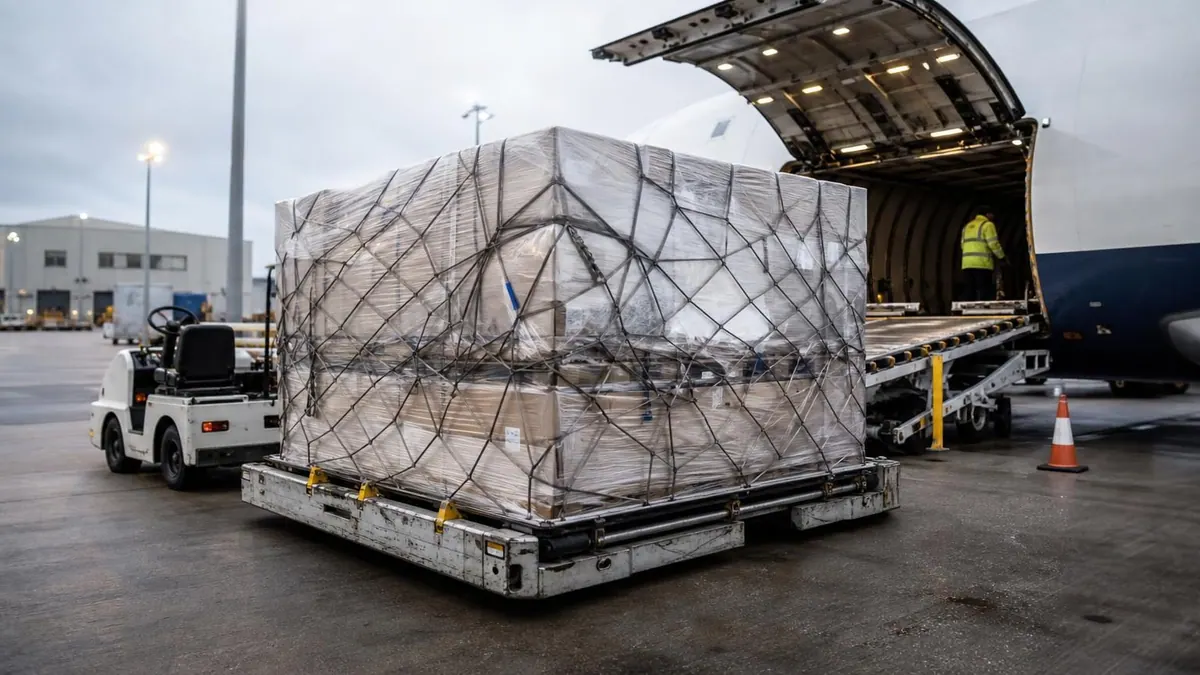
Airlines plan the space used by the freight presented for carriage. Measure the completed carton, crate, pallet or other handling unit after cushioning, wrapping, strapping and any overhang have been added. Use the greatest external point on each dimension and include protrusions that cannot be removed before acceptance.
Record:
- the greatest packed length, width and height of every size group;
- the number of pieces at each size;
- the gross weight including packaging and pallet weight;
- whether pieces can be safely stacked;
- any overhang, irregular shape or restricted handling point;
- whether the goods require dangerous-goods, temperature-controlled or specialist acceptance.
A neat product specification is not enough if the shipping crate is larger. Likewise, an early estimate from the supplier should be replaced with final packed measurements before booking. Incorrect dimensions can change aircraft compatibility, consolidation planning, handling and price.
Should the divisor be 6,000 or 5,000?
Use the divisor in the applicable carrier tariff, service rules or Jenkar quote. IATA publishes 6,000 as the general air-cargo calculation, equal to roughly 167 kg per cubic metre. Some premium, express or parcel services use 5,000, which produces a higher volume weight for the same package.
For a 120 cm × 80 cm × 60 cm pallet:
| Divisor | Volumetric weight |
|---|---|
| 6,000 | 96 kg |
| 5,000 | 115.2 kg |
The calculator lets you compare both, but choosing the lower result does not change the carrier’s rules. If no divisor has been confirmed, show the packed dimensions as well as the estimate when requesting a quote so the correct basis can be applied.
Volumetric weight is not an air-freight price
The chargeable-weight result is one input to a quote, not the total shipment cost. Air-freight pricing can also depend on:
- origin and destination airports;
- direct, consolidated, express, next-flight-out or charter service;
- ready date, deadline and available capacity;
- commodity, value and security status;
- dangerous-goods or temperature-control requirements;
- collection, screening, terminal and handling work;
- customs declarations, duties, taxes and destination charges;
- final delivery and any specialist equipment;
- rate validity, currency and carrier surcharges.
Two shipments with the same chargeable weight can therefore have different costs. A calculator cannot confirm airline acceptance, schedule availability or the full delivered price.
Can packaging reduce chargeable weight?
Reducing unused external space can lower volumetric weight, but packaging must still protect the goods and meet carrier acceptance requirements. Do not weaken a carton, remove required cushioning or create an unstable pallet solely to reach a smaller calculation.
Useful checks include removing avoidable overhang, selecting a box that fits the packed product, keeping cartons within the pallet footprint and confirming whether a different arrangement remains strong and stackable. Jenkar’s freight packaging guide explains the wider packing and responsibility boundaries.
What to send for an air-freight quote
Provide the collection point, delivery point, ready date, required arrival, goods description, number of pieces, final packed dimensions, total gross weight, cargo value and any dangerous-goods or temperature information. State whether the pieces are stackable and attach a photograph or packing drawing when the shape is irregular.
Jenkar can then confirm the applicable chargeable-weight basis, routing, handling scope and exclusions for the proposed movement. Request an air-freight quote with the calculator result and the underlying dimensions; the final quote will use the booked carrier and service rules.